Most SaaS demos do not fail because the product is weak. They fail because belief forms too late and urgency evaporates quietly.
By the five-minute mark, buyers have already decided whether this is urgent or optional. Whether it deserves serious evaluation or polite curiosity. And that decision usually happens in the first 40 seconds.
If your SaaS demo conversion rate feels lower than it should, even when discovery goes well, the issue is often sequencing, not capability.
Why SaaS Demos Lose Momentum
Most demos follow interface order:
Login → Dashboard → Feature A → Feature B
Logical if you built the product. Misaligned if you are evaluating it.
Buyers evaluate in risk order, not UI order. They are silently asking:
- Will this survive our edge case?
- Will this disrupt our workflow?
- Is this worth the switching cost?
- Can this scale without breaking?
When those questions hang unanswered, attention does not crash. It drifts, like a tab left open in the background. By minute five, your demo feels informative but not decisive.
Over the past year, we reviewed dozens of publicly available SaaS demos, from early-stage startups to Series B companies. The pattern is remarkably consistent. Most teams open with their dashboard or navigation structure, even when discovery clearly surfaced a high-stakes operational risk.
It is subtle, but once you start noticing it, you see it everywhere.
The First 40 Seconds: The Belief Checkpoint
Every SaaS demo has a belief checkpoint. It is the moment the buyer subconsciously decides: "This is worth serious evaluation." Or: "This is interesting."
Most demos spend the first 40 seconds on:
- Company background
- Platform overview
- High-level positioning
That informs. It does not anchor belief. And belief drives urgency.
Product Mode vs Problem Mode
There are two common ways demos begin.
"Let me walk you through the dashboard."
"You mentioned forecast variance is costing you $120K per quarter. Let us look at where that becomes visible and how it resolves."
The difference is subtle. In product mode, the brain shifts into exploration. In problem mode, urgency stays intact.
In one RevOps SaaS demo we reviewed, the team opened with a polished analytics homepage. During discovery, the CFO had mentioned reporting delays were costing two board cycles per quarter. That issue never appeared in the first five minutes.
The demo looked strong. The energy in the room dipped. No one objected. But no one leaned in either. Momentum softened. It is hard to describe exactly. Nothing went wrong technically, but something important did not land.
Why Discovery Alone Does Not Save the Demo
Strong discovery does not automatically produce a strong demo. Even when pain is quantified, urgency decays if the demo does not reflect that specificity immediately.
Urgency has a short half-life, especially in a 30-minute Zoom window. Actually, maybe half-life is too generous. It fades faster than that. If the quantified problem is not visible early, the conversation shifts from:
"We need to fix this."
To:
"Let us explore."
And exploration rarely accelerates decisions. What is interesting is how often enterprise buyers interrupt around minute two or three. Not because they are impatient, but because they are trying to get to the risk faster. They will say, "Can you show me how this handles X?" Translation: I am trying to decide if this breaks under pressure.
That moment is revealing. It tells you where belief actually needs to form.
The Confidence Anchor
When demos lose momentum, teams often respond by adding more depth. More features. More architecture. More use cases. But buyers are not asking for more information. They are asking for reassurance.
A confidence anchor is the first visible proof that your product can survive their highest anxiety.
For example:
- A CTO worried about integration complexity does not need a feature tour. They need to see one real integration survive constraints.
- A CFO concerned about cost predictability does not need dashboard breadth. They need to see cost variance and forecast stabilization in action.
- An operations leader anxious about disruption does not need automation theory. They need to see one workflow run without breaking dependencies.
In one enterprise SaaS demo, the team restructured their opening to show a failed API call being handled and logged correctly before anything else. That single moment reframed the session. Questions became sharper. Technical scrutiny increased in a productive way. Belief had formed.
Earn one belief early. You do not need to win the entire argument. You just need to remove the biggest doubt. The rest of the demo becomes reinforcement, not persuasion.
A Practical 40-Second SaaS Demo Framework
If you want to test a sequencing shift, try this structure:
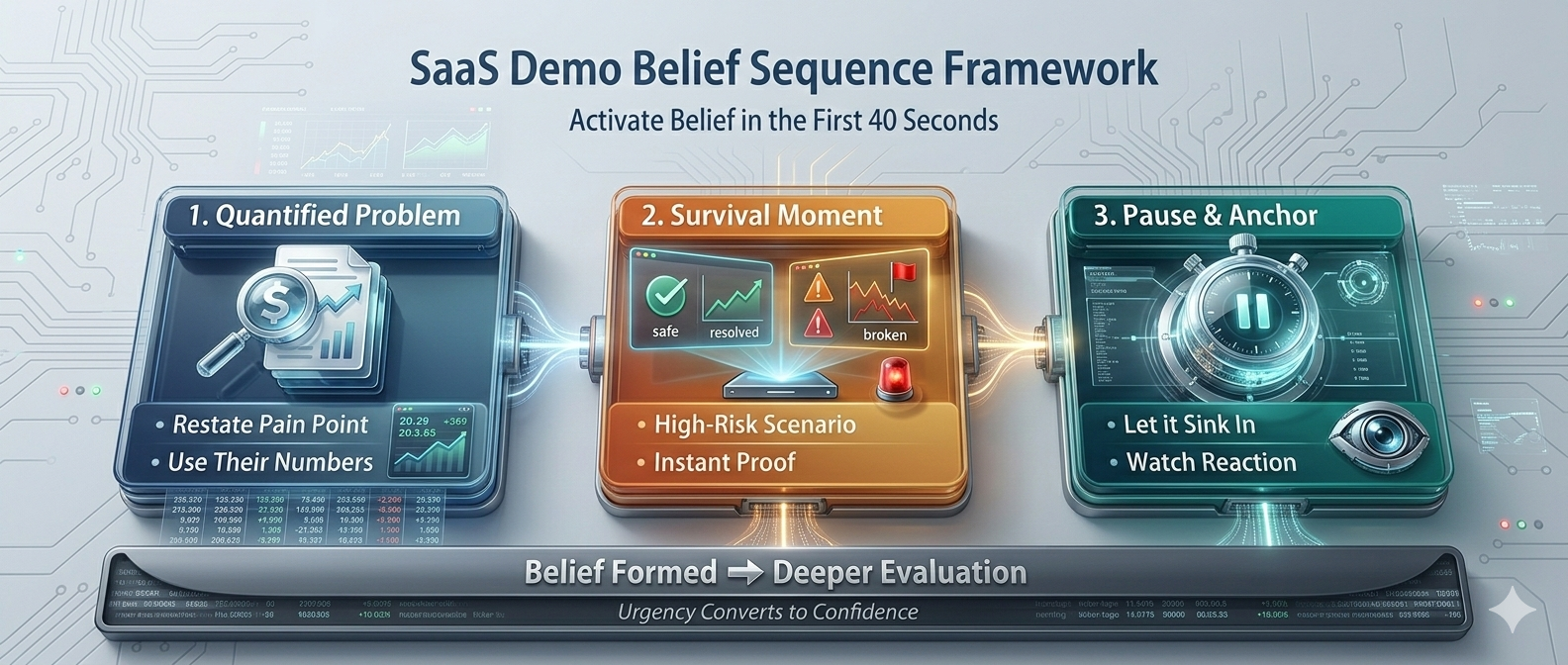
Re-anchor the quantified problem
Use their numbers. Their language. (10 to 15 seconds)
"You mentioned onboarding delays are costing 18 percent in churn over 90 days." Specificity increases credibility.
Demonstrate the survival moment (20 to 30 seconds)
Show the exact workflow, edge case, or constraint they are most anxious about.
Not the homepage.Not the overview - The risk.
Pause
Confidence often forms in silence. If belief lands here, deeper evaluation follows naturally. If it does not, no amount of feature coverage later will compensate.
Common SaaS Demo Mistakes That Kill Conversion
- Leading with overview slides
- Showing the dashboard before resolving risk
- Demonstrating breadth before earning confidence
- Treating the demo like a product tour instead of a decision environment
If buyers can replace your logo with a competitor's and the demo still works, you are presenting, not differentiating.
The Real Cost of Weak Sequencing
When belief forms too late:
- Sales cycles lengthen
- Follow-ups multiply
- Competitive pressure increases
- Discounts creep in
Buyers rarely say, "The demo lost me." They say: "Let us think about it." That softness often traces back to the first 40 seconds.
Designing Demos Around Belief, Not Features
In most SaaS teams, demo structure evolves informally, shaped by product releases, new features, and rep preferences. Very few teams deliberately design the first minute around belief formation.
I have been on demo calls where everything looked polished and still felt the energy shift when the real risk was not addressed early. It is not dramatic. It is quiet. But it changes the trajectory of the conversation. Almost imperceptibly at first.
Once that sequencing shift happens, and demos are structured around evaluation psychology instead of interface order, momentum feels different. Questions sharpen. Scrutiny increases. Objections surface earlier and resolve faster. Decisions accelerate not because pressure was added, but because uncertainty was removed.
Demos Do Not Need More Features. They Need Earlier Conviction.
The majority of SaaS teams are not struggling with capability. They are struggling with order.
If you are noticing:
- Strong discovery calls but stalled deals
- Positive demo feedback but slow decisions
- High interest but low urgency
The issue may not be your product. It may be when belief forms. Fix the first 40 seconds. The five-minute drop-off often disappears. And the demo stops feeling like a presentation and starts feeling inevitable.